Radian Laser Automation API
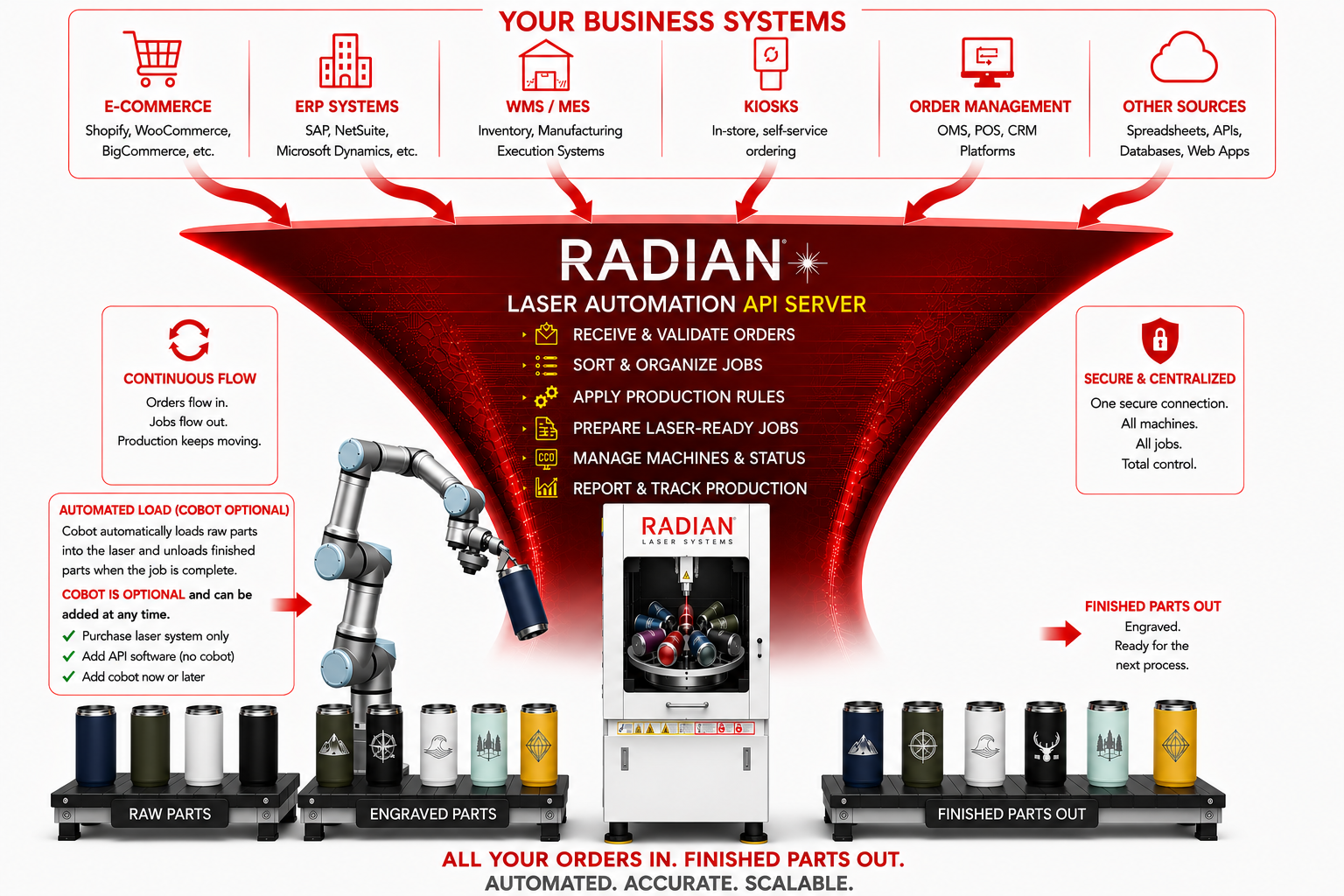
Your order data pours into the Radian API Server — the hub between your business software and your lasers — which sorts every order, preps every job, and runs your machines automatically. It masters the constantly-changing variable data behind direct-to-consumer (D2C) personalization and automates high-volume business-to-business (B2B) marking at the same time — with nothing done by hand.
Modern manufacturing needs more than a standalone laser. It needs a clean connection between your business software and your production floor. Whether orders come from your ERP, WMS, MES, order management system, or e-commerce platform, the Radian Laser Automation API turns them into laser-ready jobs — sorted, prepped, and ready to run with minimal operator interaction.
What Is the Radian Laser Automation API?
It's a software integration platform that connects your business systems directly to Radian laser systems. Instead of building a laser job by hand for every order, the job information comes from software you already run and is processed through the centralized Radian API Server.
The server prepares each job using predefined production settings and makes it available to the laser for engraving. Your software never has to talk to individual laser controllers — it talks to one API Server that manages job creation, machine communication, and production status.
A True Production Solution
B2B and D2C
Not all laser marking data is equal. The difference between business-to-business (B2B) and direct-to-consumer (D2C) production is the difference between easy data and hard variable data — and it's exactly where the Radian API earns its place.
Business-to-Business (B2B)
B2B work runs at high volume, and the data barely changes, if at all, from part to part — the same logo, part number, and layout, over and over. Even where it does vary, it varies predictably: sequential serial numbers, date codes, and asset tags for serialization and traceability. Rule-based data like this is straightforward to automate, and the API handles it at scale — including high-mix, low-volume (HMLV) runs — without breaking stride.
Direct-to-Consumer (D2C)
D2C is the hard problem — true mass customization. The data changes with every single order — a different name, message, or graphic — and the product itself can change too. Orders arrive one at a time from your e-commerce store, each a lot size of one. That constant, unpredictable variability, at a batch of one, is where most automation breaks down.
- Our customers run personalized drinkware on our CO2 lasers — a classic D2C job where every piece is different.
- Engraved data tags and nameplates on Rowmark® or Trolase® material, where serialized B2B production runs at volume. Same API, both jobs.
Why this matters: most automation can push stable B2B data to a laser. Very little can handle D2C variable data that changes on every order and every product. That capability is the Radian API's edge.
Two Ways to Integrate
Every customer has different software capabilities, so the API supports two integration methods — one for teams with developers, one for teams without.
JSON Integration
Excel-Based Job Import
From Order Data to Laser Production
Every job routes through the Radian API Server — one hub from order data to finished part. A typical workflow runs like this:
Once the server receives the job information, it prepares the engraving job using your defined production data, artwork, and validated processing parameters — automating the repetitive job-prep work while leaving you in complete control of your production process.
Variable Data & Personalized Production
The API is built for work where every part carries different information — the core of variable data marking and direct-to-consumer (D2C) personalization. That data is supplied straight from your business system instead of being keyed in by hand, job after job.
Typical Variable Data
- Customer names and variable text
- Logos and personalized graphics
- Serial numbers and product identification
- 1D and 2D barcodes including QR codes and data matrix
- Dates and batch codes
Well Suited For
- Personalized D2C goods and made-to-order products
- Drinkware, awards, and promotional products
- Signage and industrial identification
- Serialization and high-mix manufacturing
- Automated, lights-out production cells with cobot part handling
- Engraved data tags, nameplates, and asset tags on Rowmark® or Trolase® two-ply materials
One API Across Your Galvo-Based Equipment
Cobot Integration
Watch the Radian API drive the cobot and laser together — live trade-show demo
Barcode-Driven Production
The platform supports barcode- and QR-code-driven job retrieval. An operator scans a code at the laser, the laser requests the matching job from the API Server, and the server returns the right job for engraving. Less manual job selection, fewer wrong-file errors, better accuracy.
Multi-Laser Management & Production Visibility
One API Server communicates with multiple Radian lasers from a single location and reports production status in real time. That information can feed your own dashboards or manufacturing software for full visibility.
Job Status
Machine Status
Usage Statistics
Secure Network Architecture
The API connects your lasers to the server over standard, secure network communication. Each laser talks to the API Server through its own authenticated client connection, while job and status management stay centralized. The platform supports:
- Secure HTTPS communication
- TCP/IP networking
- Client authentication and individual client identification
- Secure file transfer
Why Manufacturers Choose the Radian API
Reduce Manual Job Setup
Generate laser-ready jobs automatically from the business systems you already run.
Improve Production Accuracy
Structured production data replaces manual entry, so the right job runs on the right part.
Scale Your Production
Drive multiple laser systems through one centralized API Server — grow by adding machines, not process.
Automate Part Handling
Bring a cobot under the same API for hands-free load and unload — unattended, lights-out production cells.
Increase Visibility
Monitor machine status, job progress, and production activity from a single location.
Simplify Integration
Choose modern JSON integration or Excel-based import, depending on what your team is ready for.
See the Radian API on Your Floor
Tell us about your order flow, your business systems, and the parts you produce. We'll show you what an automated pipeline looks like for your operation.
Request a Demo